R is for Resolution

Resolution is becoming a catch-all term for various aspects of the quality of a digital signal, whether it's a photograph, a sound recording, or a seismic volume.

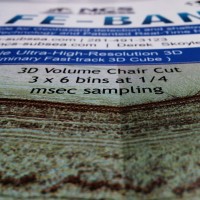
I got thinking about this on seeing an ad in AAPG Explorer magazine, announcing an 'ultra-high-resolution' 3D in the Gulf of Mexico (right), aimed at site-survey and geohazard detection. There's a nice image of the 3D, but the only evidence offered for the 'ultra-high-res' claim is the sample interval in space and time (3 m × 6 m bins and 0.25 ms sampling). This is analogous to the obsession with megapixels in digital photography, but it is only one of several ways to look at resolution. The effect of increasing the sample interval of some digital images is shown in the second column here, compared to 200 × 200 pixels originals (click to zoom):
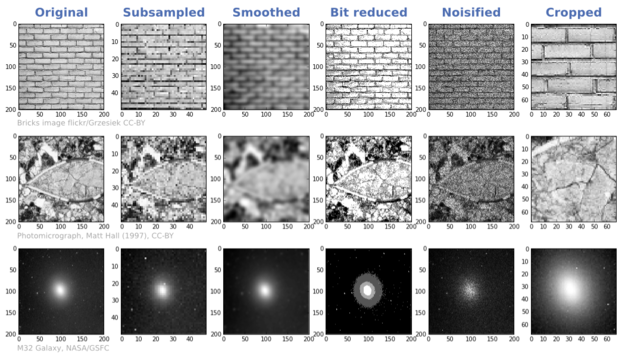
Another aspect of resolution is spatial bandwidth, which gets at resolving power, perhaps analogous to focus for a photographer. If the range of frequencies is too narrow, then broadband features like edges cannot be represented. We can simulate poor frequency content by bandpassing the data, for example smoothing it with a Gaussian filter (column 3).

Yet another way to think about resolution is precision (column 4). Indeed, when audiophiles talk about resolution, they are talking about bit depth. We usually record seismic with 32 bits per sample, which allows us to discriminate between a large number of values — but we often view seismic with only 6 or 8 bits of precision. In the examples here, we're looking at 2 bits. Fewer bits means we can't tell the difference between some values, especially as it usually results in clipping.
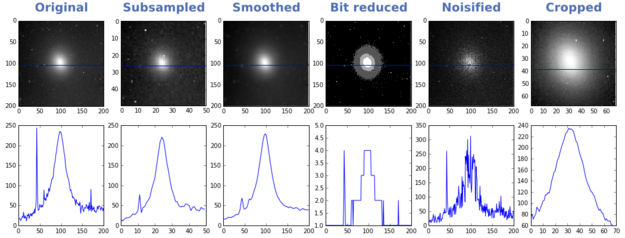
If it comes down to our ability to tell events (or objects, or values) apart, then another factor enters the fray: signal-to-noise ratio. Too much noise (column 5) impairs our ability to resolve detail and discriminate between things, and to measure the true value of, say, amplitude. So while we don't normally talk about the noise level as a resolution issue, it is one. And it may have the most variety: in seismic acquisition we suffer from thermal noise, line noise, wind and helicopters, coherent noise, and so on.

I can only think of one more impairment to the signals we collect, and it may be the most troubling: the total duration or extent of the observation (column 6). How much information can you afford to gather? Uncertainty resulting from a small window is the basis of the game Name That Tune. If the scale of observation is not appropriate to the scale we're interested in, we risk a kind of interpretation 'gap' — related to a concept we've touched on before — and it's why geologists' brains need to be helicoptery. A small 3D is harder to interpret than a large one. 

The final consideration is not a signal effect at all. It has to do with the nature of the target itself. Notice how tolerant the brick wall image is to the various impairments (especially if you know what it is), and how intolerant the photomicrograph is. In the astronomical image, the galaxy is tolerant; the stars are not. Notice too that trying to 'resolve' the galaxy (into a point, say) would be a mistake: it is inherently low-resolution. Indeed, its fuzziness is one of its salient features.

Have I missed anything? Are there other ways in which the recorded signal can suffer and targets can be confused or otherwise unresolved? How does illumination fit in here, or spectral bandwidth? What do you mean when you talk about resolution?


This post is an exceprt from my talk at SEG, which you can read about in this blog post. You can even listen to it if you're really bored. The images were generated by one of my IPython Notebooks that I point to in the talk, specifically images.ipynb

Astute readers with potent memories will have noticed that we have skipped Q in our A to Z. I just cannot seem to finish my post about Q, but I will!

The Safe Band ad is copyright of NCS SubSea. This low-res snippet qualifies as fair use for comment.

All the time freaks

SEG 2014Thursday was our last day at the SEG Annual Meeting. Evan and I took in the Recent developments in time-frequency analysis workshop, organized by Mirko van der Baan, Sergey Fomel, and Jean-Baptiste Tary (Vienna). The workshop came out of an excellent paper I reviewed this summer, which was published online a couple of weeks ago:

Tary, JB, RH Herrera, J Han, and M van der Baan (2014), Spectral estimation—What is new? What is next?, Rev. Geophys. 52. doi:10.1002/2014RG000461.

The paper compares the results of several time–frequency transforms on a suite of 'benchmark' signals. The idea of the workshop was to invite further investigation or other transforms. The organizers did a nice job of inviting contributors with diverse interests and backgrounds. The following people gave talks, several of them sharing their code (*):

  • John Castagna (Lumina) with a review of the applications of spectral decomposition for seismic analysis.
  • Steven Lin (NCU, Taiwan) on empirical methods and the Hilbert–Huang transform.
  • Hau-Tieng Wu (Toronto) on the application of transforms to monitoring respiratory patterns in animals.*
  • Marcílio Matos (SISMO) gave an entertaining, talk about various aspects of the problem.
  • Haizhou Yang (Standford) on synchrosqueezing transforms applied to problems in anatomy.*
  • Sergey Fomel (UT Austin) on Prony's method... and how things don't always work out.*
  • Me, talking about the fidelity of time–frequency transforms, and some 'unsolved problems' (for me).*
  • Mirko van der Baan (Alberta) on the results from the Tary et al. paper.

Some interesting discussion came up in the two or three unstructured parts of the session, organized as mini-panel discussions with groups of authors. Indeed, it felt like the session could have lasted longer, because I don't think we got very close to resolving anything. Some of the points I took away from the discussion:

  • My observation: there is no existing survey of the performance of spectral decomposition (or AVO) — these would be great risking tools.
  • Castagna's assertion: there is no model that predicts the low-frequency 'shadow' effect (confusingly it's a bright thing, not a shadow).
  • There is no agreement on whether the so-called 'Gabor limit' of time–frequency localization is a lower-bound on spectral decomposition. I will write more about this in the coming weeks.
  • Should we even be attempting to use reassignment, or other 'sharpening' tools, on broadband signals? To put it another way: does instantaneous frequency mean anything in seismic signals?
  • What statistical measures might help us understand the amount of reassignment, or the precision of time–frequency decompositions in general?

The fidelity of time–frequency transforms

My own talk was one of the hardest I've ever done, mainly because I don't think about these problems very often. I'm not much of a mathematician, so when I do think about them, I tend to have more questions than insights, so I made my talk into a series of questions for the audience. I'm not sure I got much closer to any answers, but I have a better idea of my questions now... which is a kind of progress I suppose.

Here's my talk (latest slidesGitHub repo). Comments and feedback are, as always, welcome.


Two sides to every story?

We all have our biases.

Ovation, a data management company, set up a sexy shoeshine stand again this year at the SEG Annual Meeting, a science & technology meeting for subsurface professionals. This cynical and spurious subordination of women by a technology company in our community should be addressed by the immediate adoption of a code of conduct by SEG.     Ovation wants to liven up a boring tradeshow. They hired a small business, owned and run by women, to provide their customers and prospects with shiny shoes. The women are smart to capitalize on their looks to make a living. Anyone who thinks they're being exploited, or that this is an inappropriate way to attract customers at a scientific conference, needs to get over themselves.
       
Last year I picked on one of the marketing strategies employed by SeisWare, a Calgary software company. I implied that the women in fitted dresses handing out beer tickets were probably marketing consultants, not scientists, and I was not alone in my misgivings. My interpretation was that the sexy gimmick was a stand-in for more geophysics-based engagement, something many vendors are afraid of.     On Tuesday, one of SeisWare's geologists called me out on this. On Twitter, in the open, where these conversations belong. She was one of the women in tight dresses; the others were also geoscientists. She had chosen the dresses, felt great about them, and been excited about the chance to represent the company and look awesome doing it. She was saddened and frustrated by the negative remarks about those choices. I need to check my assumptions next time.
       
Evan and I went to the excellently named Euclid Hall on Monday evening. It was full; whilst waiting, the maître d' told us the place was full of exploration geophysicists, to which we replied that we were geophysicists too. She went on to say that she was studying the subject at CU, prompting a high-five from Evan. Then she said, "I shouldn't say this, but I worry that I won't be taken seriously, because I'm a girl."      
 

What's the other side to this story?


Big imaging, little imaging, and telescopes

I caught three lovely talks at the special session yesterday afternoon, Recent Advances and the Road Ahead. Here are my notes...

The neglected workhorse

If you were to count up all the presentations at this convention on seismic migration, only 6% of them are on time migration. Even though it is the workhorse of seismic data processing, it is the most neglected topic in migration. It's old technology, it's a commodity. Who needs to do research on time migration anymore? Sergey does.

Speaking as an academic, Fomel said, "we are used to the idea that most of our ideas are ignored by industry," even though many transformative ideas in the industry can be traced back to academics. He noted that it takes at least 5 years to get traction, and the 5 years are up for his time migration ideas, "and I'm starting to lose hope". Here's five things you probably didn't know about time migration:

  • Time migration does not need travel times.
  • Time migration does not need velocity analysis.
  • Single offsets can be used to determine velocities.
  • Time migration does need approximations, but the approximation can be made increasingly accurate.
  • Time migration distorts images, but the distortion can be removed with regularized inversion.

It was joy to listen to Sergey describe these observations through what he called beautiful equations: "the beautiful part about this equation is that it has no parameters", or "the beauty of this equation is that is does not contain velocity", an so on. Mad respect.

Seismic adaptive optics

Alongside seismic multiples, poor illumination, and bandwidth limitations, John Etgen (BP) submitted that, in complex overburden, velocity is the number one problem for seismic imaging. Correct velocity model equals acceptable image. His (perhaps controversial) point was that when velocities are complex, multiples, no matter how severe, are second order thorns in the side of the seismic imager. "It's the thing that's killing us, and that's the frontier." He also posited that full waveform inversion may not save us after all, and image gather analysis looks even less promising.

While FWI looks to catch the wavefield and look at it in the space of the data, migration looks to catch the wavefield and look at it at the image point itself. He elegantly explained these two paradigms, and suggested that both may be flawed.

John urged, "We need things other than what we are working on", and shared his insights from another field. In ground-based optical astronomy, for example, when the image of a star is be distorted by turbulence in our atmosphere, astromoners numerically warp the curvature of the lens to correct for rapid variations in phase of the incoming wavefront. The lenses we use for seismic focusing, velocities, can be tweaked just the same by looking at the wavefield part of the way through its propagation. He quoted Jon Claerbout:

If you want to understand how a horse runs, you gotta run along with it.

Big imaging, little imaging, and combination of the two

There's a number of ways one could summarize what petroleum seismologists do. But hearing (CGG researcher) Sam Gray's talk yesterday was a bit of an awakening. His talk was a remark on the notion of big imaging vs little imaging, and the need for convergence.

Big imaging is the structural stuff. Structural migration, stratigraphic imaging, wide-azimuth acquisition, and so on. It includes the hardware and compute innovations of broadband, blended sources, deblending processing, anisotropic imaging, and the beginnings of viscoacoustic reverse-time migration. 

Little imaging is inversion. It's reservoir characterization. It's AVO and beyond. Azimuthal velocities (fast and slow directions) hint at fracture orientations, azimuthal amplitudes hint even more subtly at fracture compliance.

Big imaging is hard because it's computationally expensive, and velocities are unknown. Little imaging is hard because features like fractures, faults and pores are at the centimetre scale, but on land we lay out inlines and crossline hundreds of metres apart, and use signals that carry only a few bits of information from an area the size of a football field.

What we've been doing with imaging is what he called a separated workflow. We use gathers to make big images. We use gathers to make rock properties, but seldom do they meet. How often have you tested to see if the rock properties the little are explain the wiggles in the big? Our work needs to be such a cycle, if we want our relevance and impact to improve.

The figures are copyright of the authors of SEG, and used in accordance with SEG's permission guidelines.

The most epic geophysics hackathon in the world, ever

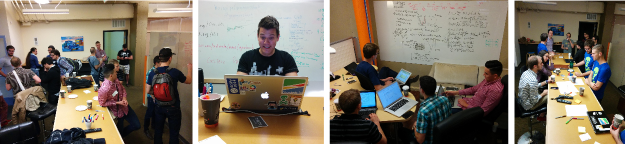
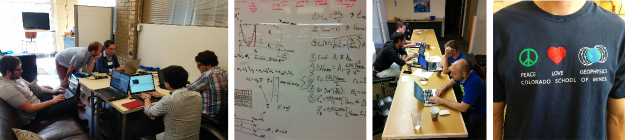
Words can't express how awesome the 2014 Geophysics Hackthon was. The spirit embodied by the participants is shared by our generous sponsors... the deliberate practice of creativity and collaboration. 

We convened at Thrive, a fantastic coworking space in the hip Lower Downtown district of Denver. Their friendly staff went well beyond their duty in accommodating our group. The abundance of eateries and bars makes it perfect for an event like this, especially when the organization is a bit, er, spontaneous.

We opened the doors at 8 on Saturday morning and put the coffee and breakfast out, without any firm idea of how many people would show up. But by 9 a sizeable cohort of undergrads and grad students from the Colorado School of Mines had already convened around projects, while others trickled in. The way these students showed up, took ownership, and rolled up their sleeves was inspiring. A few folks even spent last week learning Android in order to put their ideas on a mobile device. While at times we encounter examples that have caused us to wonder if we are going to be alright, these folks, with their audacity and wholesomeness, revive faith that we will. 

The theme of the event was resolution, but really the brief was wide open. There was a lot of non-seismic geophysics, a lot of interactive widgets ('slide this to change the thickness; slide that to change the resistivity'), and a lot of novel approaches. In a week or two we'll be posting a thorough review of the projects the 6 teams built, so stay tuned for that.

The photos are all on Flickr, or you can visit our Hashpi.pe for the captions and other tweetage.

Another great outcome was that all of the projects are open source. Several of the projects highlighted the escape-velocity innovation that is possible when you have an open platform behind you. The potential impact of tools like Mines JTK, SimPEG, and Madagascar is huge. Our community must not underestimate the super-powers these frameworks give us.

The hackathon will be back next year in New Orleans (17 and 18 October: mark your calendars!). We will find a way to add a hacker bootcamp for those wanting to get into this gig. And we're looking for ways to make something happen in Europe. If you have a bright idea about that, please get in touch

SEG 2014: sampling from the smorgasbord

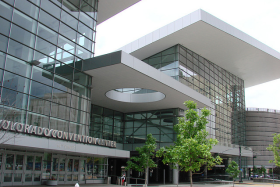
Next week, Matt and I will be attending the 2014 SEG Annual General Meeting at the Colorado Convention Centre in Denver. Join the geo-tweeting using the hashtag #SEG2014 and stay tuned on the blog for our daily highlights.

Fitness training

I spent a couple of hours yesterday reviewing the conference schedule in an attempt to form an opinion on what deserved my attention. The meeting boasts content from over 1600 abstract submissions which it has dispersed over three formats: oral presentations, poster presentations, and oral discussions/e-posters (looking forward to finding out how these work). Any given moment there will be 12 oral, 3 poster, and 6 e-poster presentations going on, not to mention all the happenings on the exhibition floor. A worthy test for my navigation skills, discipline, and endurance, as well as the new and improved SEG events mobile app.

The technical program

There are 101 sessions in the technical program, each with around 8 presentations. Six of these sessions are dubbed special sessions, hosting either invited speakers from other domains such as hydrogeophysics and completions engineering, or a heavyweight lineup of seismic celebs. Special session numero uno, entitled Recent Advances And The Road Ahead is  the session that I'm most looking forward to. It kicks off the technical program on Monday afternoon with talks from:

  • Christof Stork (ION Geophysical), The decline of conventional seismic acquisition and the rise of specialized acquisition: this is compressive sensing.
  • Sergy Fomel (UT Austin), Recent advances in time-domain seismic imaging. 
  • John Etgen (BP), Seismic adaptive optics. 
  • Kurt Marfurt (Univ. of Oklahoma), Seismic attributes and the road ahead. 
  • Reinarldo Michelena (iReservoir), Flow simulation models for unconventional reservoirs: The role of seismic data.

Other presentations throughout the week that have made it onto my must-see list:

  • Andreas Rüger (Halliburton), A practitioner's approach to full waveform inversion.
  • Lewis Li (Stanford), Uncertainty maps for seismic images through geostatistical model randomization.
  • Kevin Liner (Univ. of Arkansas), Study of basement rocks in Northeastern Oklahoma with 3D seismic and well logs.
  • Xinyuan Luan (China Univ. of Petroleum), Laboratory measurements of brittleness anisotropy in synthetic shale with different cementation.
  • Anya Reitz (Colorado School of Mines), Feasibility of surface and borehole time-lapse gravity for SAGD monitoring.
  • Cai Lu (Univ. of Electronic Science and Technology of China), Application of multi-attributes fused volume rendering techniques in 3D seismic interpretation.

To top it all off on Thursday afternoon, Matt and I will be at workshop number 9, Latest Developments in Time-Frequency Analysis. It is one of many post convention workshops worth sticking around for after the booths get torn down and the the exhibition doors close.

SEG Wikithon

If you read The Leading Edge frequently or if you visit the SEG website regularly, you may have noticed an increased presence of SEG Wiki. Matt and his allies Isaac Farley and Andrew Geary will be parked in Room 708 between 12–2pm and 5–6pm October 26–29. For more information about SEG Wiki and the Wikithon, check out Isaac's article from the September issue, and find out all the details on wiki page (naturally).

Whatever you want to call it

Lastly, I couldn't help but snag a selection of the coolest names from the technical session. I can only imagine what the organizing committee was thinking:

Well, they got my attention. And with so much content to choose from, maybe that's all that matters.

Image by user bonjourpeewee on flickr, licensed CC-BY-SA.

Why don't people use viz rooms?

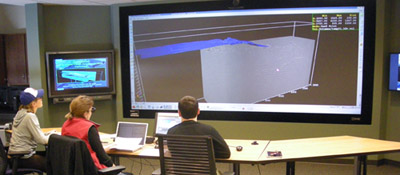
Matteo Niccoli asked me why I thought the use of immersive viz rooms had declined. Certainly, most big companies were building them in about 1998 to 2002, but it's rare to see them today. My stock answer was always "Linux workstations", but of course there's more to it than that.

What exactly is a viz room?

I am not talking about 'collaboration rooms', which are really just meeting rooms with a workstation and a video conference phone, a lot of wires, and wireless mice with low batteries. These were one of the collaboration technologies that replaced viz rooms, and they seem to be ubiquitous (and also under-used).

The Viz Lab at Wisconsin–Madison. Thanks to Harold Tobin for permission.A 'viz room', for our purposes here, is a dark room with a large screen, at least 3 m wide, probably projected from behind. There's a Crestron controller with greasy fingerprints on it. There's a week-old coffee cup because not even the cleaners go in there anymore. There's probably a weird-looking 3D mouse and some clunky stereo glasses. There might be some dusty haptic equipment that would work if you still had an SGI.

Why did people stop using them?

OK, let's be honest... why didn't most people use them in the first place?

  1. The rise of the inexpensive Linux workstation. The Sun UltraSPARC workstations of the late 1990s couldn't render 3D graphics quickly enough for spinning views or volume-rendered displays, so viz rooms were needed for volume interpretation and well-planning. But fast machines with up to 16GB of RAM and high-end nVidia or AMD graphics cards came along in about 2002. A full dual-headed set-up cost 'only' about $20k, compared to about 50 times that for an SGI with similar capabilities (for practical purposes). By about 2005, everyone had power and pixels on the desktop, so why bother with a viz room?
  2. People never liked the active stereo glasses. They were certainly clunky and ugly, and some people complained of headaches. It took some skill to drive the software, and to avoid nauseating spinning around, so the experience was generally poor. But the real problem was that nobody cared much for the immersive experience, preferring the illusion of 3D that comes from motion. You can interactively spin a view on a fast Linux PC, and this provides just enough immersion for most purposes. (As soon as the motion stops, the illusion is lost, and this is why 3D views are so poor for print reproduction.)
  3. They were expensive. Early adoption was throttled by expense  (as with most new technology). The room renovation might cost $250k, the SGI Onyx double that, and the projectors were $100k each. But  even if the capex was affordable, everyone forgot to include operating costs — all this gear was hard to maintain. The pre-DLP cathode-ray-tube projectors needed daily calibration, and even DLP bulbs cost thousands. All this came at a time when companies were letting techs go and curtailing IT functions, so lots of people had a bad experience with machines crashing, or equipment failing.
  4. Intimidation and inconvenience. The rooms, and the volume interpretation workflow generally, had an aura of 'advanced'. People tended to think their project wasn't 'worth' the viz room. It didn't help that lots of companies made the rooms almost completely inaccessible, with a locked door and onerous booking system, perhaps with a gatekeeper admin deciding who got to use it.
  5. Our culture of PowerPoint. Most of the 'collaboration' action these rooms saw was PowerPoint, because presenting with live data in interpretation tools is a scary prospect and takes practice.
  6. Volume interpretation is hard and mostly a solitary activity. When it comes down to it, most interpreters want to interpret on their own, so you might as well be at your desk. But you can interpret on your own in a viz room too. I remember Richard Beare, then at Landmark, sitting in the viz room at Statoil, music blaring, EarthCube buzzing. I carried on this tradition when I was at Landmark as I prepared demos for people, and spent many happy hours at ConocoPhillips interpreting 3D seismic on the largest display in Canada.  

What are viz rooms good for?

Don't get me wrong. Viz rooms are awesome. I think they are indispensable for some workflows: 

  • Well planning. If you haven't experienced planning wells with geoscientists, drillers, and reservoir engineers, all looking at an integrated subsurface dataset, you've been missing out. It's always worth the effort, and I'm convinced these sessions will always plan a better well than passing plans around by email. 
  • Team brainstorming. Cracking open a new 3D with your colleagues, reviewing a well program, or planning the next year's research projects, are great ways to spend a day in a viz room. The broader the audience, as long as it's no more than about a dozen people, the better. 
  • Presentations. Despite my dislike of PowerPoint, I admit that viz rooms are awesome for presentations. You will blow people away with a bit of live data. My top tip: make PowerPoint slides with an aspect ratio to fit the entire screen: even PowerPoint haters will enjoy 10-metre-wide slides.

What do you think? Are there still viz rooms where you work? Are there 'collaboration rooms'? Do people use them? Do you?

October linkfest

The linkfest has come early this month, to accommodate the blogging blitz that always accompanies the SEG Annual Meeting. If you're looking forward to hearing all about it, you can make sure you don't miss a thing by getting our posts in your email inbox. Guaranteed no spam, only bacn. If you're reading this on the website, just use the box on the right →


Open geoscience goodness

I've been alerted to a few new things in the open geoscience category in the last few days:

  • Dave Hale released his cool-looking fault detection code
  • Wayne Mogg released some OpendTect plugins for AVO, filtering, and time-frequency decomposition
  • Joel Gehman and others at U of A and McGill have built WellWiki, a wiki... for wells!
  • Jon Claerbout, Stanford legend, has released his latest book with Sergey Formel, Austin legend: Geophysical Image Estimation by Example. As you'd expect, it's brilliant, and better still: the code is available. Amazing resource.

And there's one more resource I will mention, but it's not free as in speech, only free as in beerPetroacoustics: A Tool for Applied Seismics, by Patrick Rasolofosaon and Bernard Zinszner. So it's nice because you can read it, but not that useful because the terms of use are quite stringent. Hat tip to Chris Liner.

So what's the diff if things are truly open or not? Well, here's an example of the good things that happen with open science: near-real-time post-publication peer review and rapid research: How massive was Dreadnoughtus?

Technology and geoscience

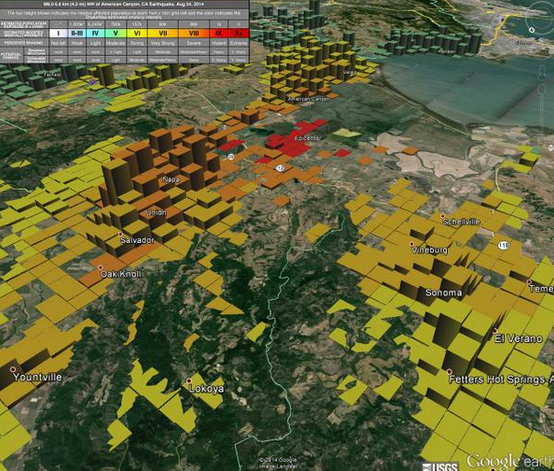
Napa earthquakeOpen data sharing has great potential in earthquake sensing, as there are many more people with smartphones than there are seismometers. The USGS shake map (right) is of course completely perceptual, but builds in real time. And Jawbone, makers of the UP activity tracker, were able to sense sleep interruption (in their proprietary data): the first passive human-digital sensors?

We love all things at the intersection of the web and computation... so Wolfram Alpha's new "Tweet a program" bot is pretty cool. I asked it:

GeoListPlot[GeoEntities[=[Atlantic Ocean], "Volcano"]]

And I got back a map!

This might be the coolest piece of image processing I've ever seen. Recovering sound from silent video images:

Actually, these time-frequency decompositions [PDF] of frack jobs are just as cool (Tary et al., 2014, Journal of Geophysical Research: Solid Earth 119 (2), 1295-1315). These deserve a post of their own some time.

It turns out we can recover signals from all sorts of unexpected places. There were hardly any seismic sensors around when Krakatoa exploded in 1883. But there were plenty of barometers, and those recorded the pressure wave as it circled the earth — four times! Here's an animation from the event.

It's hard to keep up with all the footage from volcanic eruptions lately. But this one has an acoustic angle: watch for the shockwave and the resulting spontaneous condensation in the air. Nonlinear waves are fascinating because the wave equation and other things we take for granted, like the superposition principle and the speed of sound, no longer apply.

Discussion and collaboration

Our community has a way to go before we ask questions and help each other as readily as, say, programmers do, but there's enough activity out there to give hope. My recent posts (one and two) about data (mis)management sparked a great discussion both here on the blog and on LinkedIn. There was also some epic discussion — well, an argument — about the Lusi post, as it transpired that the story was more complicated that I originally suggested (it always is!). Anyway, it's the first debate I've seen on the web about a sonic log. And there continues to be promising engagement on the Earth Science Stack Exchange. It needs more applied science questions, and really just more people. Maybe you have a question to ask...?

Géophysiciens avec des ordinateurs

Don't forget there's the hackathon next weekend! If you're in Denver, free come along and soak up the geeky rays. If you're around on the afternoon of Sunday 26 October, then drop by for the demos and prizes, and a local brew, at about 4 pm. It's all happening at Thrive, 1835 Blake Street, a few blocks north of the convention centre. We'll all be heading to the SEG Icebreaker right afterwards. It's free, and the doors will be open.

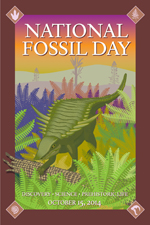
A fossil book

We're proud to announce the latest book from Agile Libre. Woot!

I can't take a lot of credit for this book... The idea came from 52 Things stalwart Alex Cullum, a biostratigrapher I met at Statoil in Stavanger in my first proper job. A fellow Brit, he has a profound enthusiasm for all things outside, and for writing and publishing. With able help from Allard Martinius, also a Statoil scientist and a 52 Things author from the Geology book, Alex generously undertook the task of inviting dozens of awesome palaeontologists, biostratigraphers, palynologists, and palaeobotanists from all over the world, and keeping in touch as the essays came in. Kara and I took care of the fiddly bits, and now it's all nearly done. It is super-exciting. Just check out some of the titles:

  • A trace fossil primer by Dirk Knaust
  • Bioastronomy by Simon Conway Morris
  • Ichnology and the minor phyla by S George Pemberton
  • A walk through time by Felix Gradstein
  • Can you catch criminals with pollen? by Julia Webb
  • Quantitative palaeontology by Ben Sloan

It's a pretty mouthwatering selection, even for someone like me who mostly thinks about seismic these days. There are another 46 like this. I can't wait to read them, and I've read them twice already.

Help a micropalaeontologist

The words in these books are a gift from the authors — 48 of them in this book! — to the community. We cherish the privilege of reading them before anyone else, and of putting them out into the world. We hope they reach far and have impact, inspiring people and starting conversations. But we want these books to give back to the community in other ways too, so from each sale we are again donating to a charity. This time it's the Educational Trust of The Micropalaeontological Society. I read about this initiative in a great piece for Geoscientist by Haydon Bailey, one of our authors: Micropalaeontology under threat!. They need our community's support and I'm excited about donating to them.

The book is in the late stages of preparation, and will appear in the flesh in about the middle of November. To make sure you get yours as soon as it's ready, you can pre-order it now.

Pre-order now from Amazon.com 
Save almost 25% off the cover price!

It's $14.58 today, but Amazon sets the final price...

Great geophysicists #12: Gauss

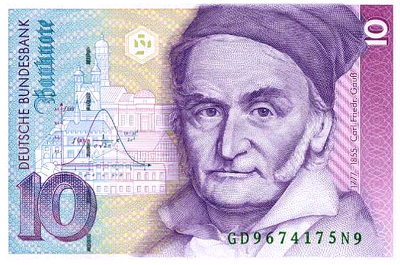
Carl Friedrich Gauss was born on 30 April 1777 in Braunschweig (Brunswick), and died at the age of 77 on 23 February 1855 in Göttingen. He was a mathematician, you've probably heard of him; he even has his own Linnean handle: Princeps mathematicorum, or Prince of mathematicians (I assume it's the royal kind, not the Purple Rain kind — ba dum tss).

Gauss's parents were poor, working class folk. I wonder what they made of their child prodigy, who allegedly once stunned his teachers by summing the integers up to 100 in seconds? At about 16, he was quite a clever-clogs, rediscovering Bode's law, the binomial theorem, and the prime number theorem. Ridiculous.

His only imperfection was that he was too much of a perfectionist. His motto was pauca sed matura, meaning "few, but ripe". It's understandable how someone so bright might not feel much need to share his work, but historian Eric Temple Bell reckoned that if Gauss had published his work regularly, he would have advanced mathematics by fifty years.

He was only 6 when Euler died, but surely knew his work. Euler is the only other person who made comparably broad contributions to what we now call the exploration geophysics toolbox, and applied physics in general. Here are a few: 

  • He proved the fundamental theorems of algebra and arithmetic. No big deal.
  • He formulated the Gaussian function — which of course crops up everywhere, especially in geostatistics. The Ricker wavelet is a pulse with frequencies distributed in a Gaussian.
  • The gauss is the cgs unit of magnetic flux density, thanks to his work on the flux theorem, one of Maxwell's equations.
  • He discovered the Cauchy integral theorem for contour integrals but did not publish it.
  • The 'second' or 'total' curvature — a coordinate-system-independent measure of spatial curvedness — is named after him.
  • He made discoveries in non-Euclidean geometry, but did not publish them.

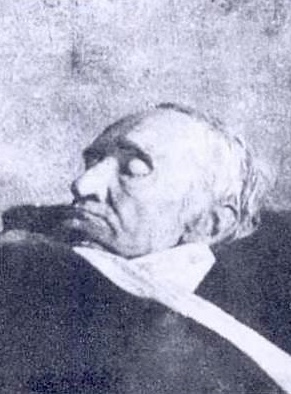
Excitingly, Gauss is the first great geophysicist we've covered in this series to have been photographed (right). Unfortunately, he was already dead. But what an amazing thing, to peer back through time almost 160 years.

Next time: Augustin-Jean Fresnel, a pioneer of wave theory.