Scientists not prospects

If you've never worked on 'the dark side' — selling technical products and services — you may not think much about marketing. If you work for an energy company, and especially if you're a 'decision maker' (wait, don't we all make decisions?), you may not realize that it's all aimed at you. Every ad, every sponsored beer, every trade show booth and its cute bunnies. The marketers are the explorers, and you are the prospect.

My question is: are you OK with their exploration methods?

The cost of advertising

Marketing futurists have been saying for ages that interruption advertising is dead. Uncurated, highest-bidder, information-free ads, 'inserted' (that's what they call it) into otherwise interesting and useful 'content' do not work. Or at least, people can't agree on whether they work or not. And that means they don't. 

The price of print advertising does not reflect this, however. Quite the opposite. Here's what a year of premium full-page ads will cost you in three leading publications: 

Still not bad compared to Wired ($1.67 million). You start to understand why companies hire marketing people. Negotiating volume pricing and favourable placements is a big deal, think of the money you can save. What a shame ads bring nothing at all to our community. All that money — so little impact. Well, zero impact. 

Conferences are where it really gets serious. Everything has a price. Want to buy 250 gallons of filtrate, I mean 'sponsor a coffee break'? That will be $5000 but don't worry, you get a little folded card with your name on it (and some coffee stains). How about a booth in the exhibition? They are only $23 per sq ft (about $250/m2), so that big shiny booth? That'll be about $75,000. That's before you bring in carpet, drywall, theatrical lighting, displays, and an espresso machine.

No wonder one service company executive once told me: "It's not a waste of money. It's a colossal waste of money." He said they only went because people would talk if they didn't.

Welcome to the oil industry

Walking around the trade show at SEG the other week, we were not very surprised to be accosted by a troop of young women dressed in identical short, tight dresses, offering beer tickets. Where's the beer? At their booth, obviously, about half a kilometre away (Manhattan distance). Apparently the marketing department assumed that no-one in their right mind would visit their booth on the basis of their compelling products or their essential relationships with an engaged and enthusiastic user community. Come to think of it, they were probably correct.

One innovative company has invented time travel, but unfortunately only to 1975. At least, that's the easiest way to explain the shoeshine stand at Ovation's booth. You can imagine the marketing meeting: "Let's get some women in short skirts, and get them to shine people's shoes!" I expect someone said, "Wait, isn't this a technical conference for subsurface scientists, shouldn't we base our marketing strategy on delighting the industry with our unbeatable services?" — and after a moment's reflection, the raucous laughter confirming that yes, the sexy shoeshine stand was indeed an awesome idea.

Let's be clear: marketing, as practised in this industry, is a waste of money. And this latter kind of marketing — remarkable for all the wrong reasons — is an insult to our profession and our purpose. 

Are we cool with this?

Last year I asked whether we (our community of technical practitioners and scientists) are okay with burning 210 person-years of productivity at a major conference and having very little to show for it at the end. 

Today I'm asking a different question: are we okay with burning millions of dollars on glossy ads, carpeted booths, nasty coffee, and shoeshine stands? Is this an acceptable price for our attention? Is the signal:noise ratio high enough?

I am not sure where I'm going with all of this — I am still trying to figure out what I think about it all. But I know one thing: I can't stand it. I will not step into another exhibition. I am withdrawing my attention — which I suppose means that yours is now worth a tiny bit more. Or less.

Update on 2013-10-16 17:10 by Matt Hall

Anyone involved in marketing that has actuallyl read this far without surfing off in disgust might like to carry on reading the follow-up to this post — Do something that scares you.
Great geophysicists #9: Ernst Chladni

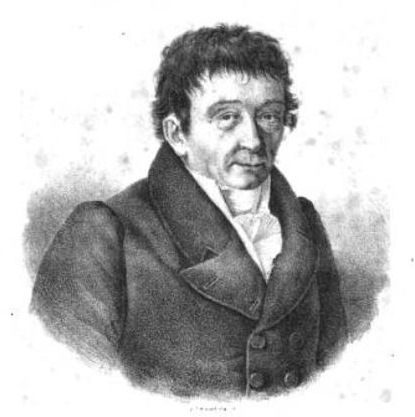
Ernst Chladni was born in Wittenberg, eastern Germany, on 30 November 1756, and died 3 April 1827, at the age of 70, in the Prussian city of Breslau (now Wrocław, Poland). Several of his ancestors were learned theologians, but his father was a lawyer and his mother and stepmother from lawyerly families. So young Ernst did well to break away into a sound profession, ho ho, making substantial advances in acoustic physics. 

Chladni, 'the father of acoustics', conducted a large number of experiments with sound, measuring the speed of sound in various solids, and — more adventurously — in several gases too, including oxygen, nitrogen, and carbon dioxode. Interestingly, though I can find only one reference to it, he found that the speed of sound in Pinus sylvestris was 25% faster along the grain, compared to across it — is this the first observation of acoustic anisotropy? 

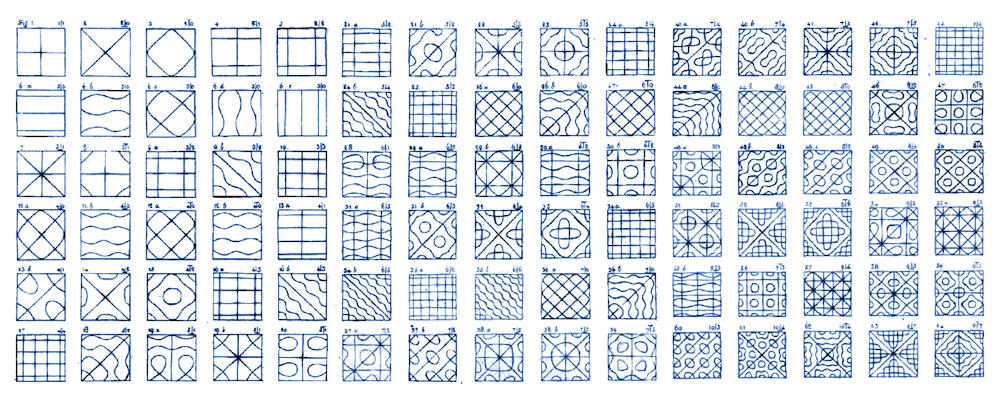
The experiments Chladni is known for, however, are the plates. He effectively extended the 1D explorations of Euler and Bernoulli in rods, and d'Alembert in strings, to the 2D realm. You won't find a better introduction to Chladni patterns than this wonderful blog post by Greg Gbur. Do read it — he segués nicely into quantum mechanics and optics, firmly linking Chladni with the modern era. To see the patterns forming for yourself, here's a terrific demonstration (very loud!)...

The drawings from Chladni's book Die Akustik are almost as mesmerizing as the video. Indeed, Chladni toured most of mainland Europe, demonstrating the figures live to curious Enlightenment audiences. When I look at them, I can't help wondering if there is some application for exploration geophysics — perhaps we are missing something important in the wavefield when we sample with regular acquisition grids?

References

Chladni, E, Die Akustik, Breitkopf und Härtel, Leipzig, 1830. Amazingly, this publishing company still exists.

Read more about Chladni in Wikipedia and in monoskop.org — an amazing repository of information on the arts and sciences. 

This post is part of a not-very-regular series of posts on important contributors to geophysics. It's going rather slowly — we're still in the eighteenth century. See all of them, and do make suggestions if we're missing some!

What we built at the weekend

10 days ago we wrapped up the Geophysics Hackathon in Houston. I wrote a bit about it right after the event, but now I've gathered the evidence and can share more of the awesome. First of all — what did everyone build in the 2 days? 

Team 1: Velocity modelling in iOS

Essau Worthy-Blackwell (Southwestern Energy), Jacob Foshee (independent iOS dev), Evan Bianco (Agile), and Ben Bougher (independent, mostly helping Agile) built 2 tools exploring velocity modelling and depth conversion. One was a desktop tool (in Python), the other was an iOS app — watch this.

Team 2: LAS soup demux

Joe Jennings (Colorado School of Mines), Mike Stone (Lukoil), and Karl Schleicher (University of Texas at Austin) built a tool in Python for coping with messy data. Karl is a champion of open data, and needs a tool for quickly exploring large repositories. You can see their progress in the code in GitHub — feel free to help them out!

Team 3: A 1D forward model

Duncan Child (Spectraseis) joined Chris Chalcraft, Paul Garossino, and James Alison from OpenGeoSolutions to help out with his pumped up Java and JSON wrangling skills. Greg Partyka even popped in to help. Here is Blockfilter in GitHub.

Everyone's a winner

As well as being a fun way to get to know people, and create something new together, the event was a (very low key) contest. We had some experienced and perceptive judges to pick some winners and decide how the exactly 3 prizes would be distributed among the exactly 3 teams:

  • Team 3 were awarded with some Raspberry Pi starter kits, to recognize their solid idea, well-constructed code, and respect for work-life balance (hey, it was the weekend!). It was fun peeking over their shoulders occasionally.

  • Team 2 had the most commercially viable product, and as such went away with 2 books: The Lean Startup by Eric Ries, and Business Model Generation by Alex Osterwalder. Thanks to sponsor SURGE Accelerator, the team also won the chance to talk to a business mentor about their ideas.

  • Team 1 delivered the shiniest product at the end of the weekend, with the iOS app and a desktop clone. They each won one of Google's latest Nexus 7 tablets, to continue with their app-building skills.

What will you build?

Thanks again to the daredevils who showed up, the judges — especially Maitri Erwin, who helped out in lots of ways all weekend — and of course the sponsors: OpenGeoSolutions, Enthought, and dGB Earth Sciences. If you missed the event, dear reader, I hope you'll come along next time to share ideas, test workflows, and build new things.

Grand challenges, anisotropy, and diffractions

Some more highlights from the two final days of the SEG Annual Meeting in Houston.

Grand challenges

On Friday, I reported on Chevron's take on the unsolved problems in petroleum geoscience. It was largely about technology. Ken Tubman, VP of Geoscience and Reservoir Engineering at ConocoPhillips gave an equally compelling outlook on some different issue. He had five points:

  • Protect the base — Fighting the decline of current production is more challenging than growing production.
  • Deepwater — Recent advances in drilling are providing access to larger fields in deep water, and compressed sampling in seismic will make exploration more efficient.
  • Unconventionals — In regard to the shale gas frenzy, it is not yet obvious why these reservoirs produce the way that they do. Also, since resource plays are so massive, a big challenge will be shooting larger surveys on land.
  • Environment and safety — Containment assurance is more critical than pay-zone management, and geophysics will find an expanding role in preventing and diagnosing environmental and safety issues.
  • People — Corporations are concerned about maintaining world class people. Which will only become more difficult as the demographic bump of senior knowledge heads off into retirement.

The Calgary crowd that harvested the list of unsolved problems at our unsession in May touched on many of these points, and identified many others that went unmentioned in this session.

Driving anisotropic ideas

In the past, seismic imaging and wave propagation were almost exclusively driven by isotropic ideas. In the final talk of the technical program, Leon Thomsen asserted that the industry has been doing AVO wrong for 30 years, and doing geomechanics wrong for 5 years. Three take-aways:

  • Isotropy is no longer an acceptable approximation. It is conceptually flawed to relate Young's modulus (an elastic property), to brittleness (a mode of failure). 
  • Abolish the terms vertically transverse isotropy (VTI), and horizontally transverse isotropy (HTI) from our vocabulary; how confusing to have types of anisotropy with isotropy in the name! Use polar anisotropy (for VTI), and azimuthal anisotropy (for HTI) instead.
  • λ13 is a simple expression of P-wave modulus M, and Thomsen's polar anisotropy parameter δ, so it should be attainable with logs.

Bill Goodway, whose work with elasticity has been criticized by Thomsen, walked to the microphone and pointed out to both the speaker and audience, that the tractability of λ13 is what he has been saying all along. Colin Sayers then stood up to reiterate that geomechanics is the statistics of extremes. Anisotropic rock physics is uncontestable, but the challenge remains to find correlations with things we actually measure.

Thomas Young's sketch of 2-slit diffraction, which he showed to the Royal Society in 1803.

Imaging fractures using diffractions

Diffractions are fascinating physical phenomena that occur when the conditions of wave propagation change dramatically. They are a sort of grey zone between reflection and scattering, and can be used to resolve fractures in the subsufrace. The question is whether or not there is enough diffraction energy to detect the fractures; it can be 10× smaller than a specular reflection, so one needs very good data acquisition. Problem is, we must subtract reflections — which we deliberately optimized for — from the wavefield to get diffractions. Evgeny Landa, from Opera Geophysical, was terse, 'we must first study noise, in this case the noise is the reflections... We must study the enemy before we kill it.'

Prospecting with plate tectonics

The Santos, Campos, and Espirito Basins off the coast of Brazil contain prolific oil discoveries and, through the application of plate tectonics, explorers have been able to extend the play concepts to offshore western Africa. John Dribus, Geological Advisor at Schlumberger, described a number of discoveries as 'kissing cousins' on either side of the Atlantic, using fundamental concepts of continental margin systems and plate tectonics (read more here). He spoke passionately about big ideas, and acknowledged collaboration as a necessity: 'if we don't share our knowledge we re-invent the wheel, and we can't do that any longer'.

In the discussion session afterwards, I asked him to comment on offshore successes, which has historically hovered around 14–18%. He noted that a step change — up to about 35% — in success occured in 2009, and he gave 3 causes for it: 

  • Seismic imaging around 2005 started dealing with anisotropy appropriately, getting the images right.
  • Improved understanding of maturation and petroleum system elements that we didn’t have before.
  • Access to places we didn’t have access to before.

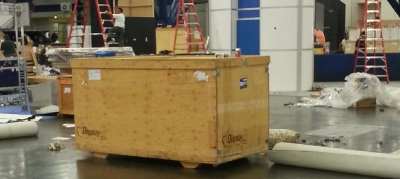
Although the workshop format isn't all that different from the relentless PowerPoint of the technical talks, it did have an entirely different feeling. Was it the ample discussion time, or the fact that the trade show, now packed neatly in plywood boxes, boosted the signal:noise? Did you see anything remarkable at a workshop last week? 

Key technology trends in earth science

Yesterday, I went to the workshop entitled, Grand challenges and research opportunities in geophysics, organized by Cengiz Esmersoy, Wafik Beydoun, Colin Sayers, and Yoram Shoham. I was curious if there'd be overlap with the Unsolved Problems Unsession we hosted in Calgary, and had reservations about it being an overly fluffy talkshop, but it was much better than I expected.

Ken Tubman, VP of Geosciences and Reservoir Engineering at ConocoPhillips, gave a splendid talk to open the session. But it was the third talk of the session, from Mark Koelmel, General Manager of Earth Sciences at Chevron, that resonated most with me. He highlighted 5 trends in applied earth science.

Data and information management

Data volumes are expanding with Moore's law. Chevron has more than 15 petabytes of data, by 2020 they will have more than 100PB. Koelmel postulated that spatial metadata and tagging will become pervasive and our data formats will have to evolve accordingly. Instead of managing ridiculously large amounts of data, a better solution may be to 'tag it and chuck it in the closet' — Google's approach to the web (and we know the company has been exploring the use of Hadoop). Beyond hardware, he stressed that new industry standards are needed now. The status quo is holding us back.

Full azimuth seismic data

Only recently have we been able to wield the computing power to deal with the kind of processes needed for full-waveform inversion. It's not only because of data volumes that new processing facilities will not be cheap — or small. He predicted processing centres that resemble small cities in terms of their power consumption. An interesting notion of energy for energy, and the reason for recent massive growth in Google's power production capability. (Renewables for power, oil for cooling... how funny would that be?)

Interpretive seismic processing and imaging

Interpretation, and processing are actually the same thing. The segmentation of seismic technology will have to be stitched back together. Imagine the interpreter working on field data, with a mixing board to produce just the right image for today's work. How will service companies (who acquire data and make images), and operators (who interpret data and make prospects) merge their efforts? We may have to consider different business relationships.

Full-cycle interpretation systems

The current state of integration is sequential at best, each node in a workflow produces static inputs for the next step, with minimal iteration in between. Each component of the sequence typically ends with 'throwing things over the wall' to the next node. With this process, the uncertainties are cumulative throughout, which is unnerving because we don't often know what the uncertainties are. Koelmel's desired future state is one of seamless geophysical processing, static model-building, and dynamic reservoir simulation. It won't reduce uncertainties altogether, but by design it will make them easier to identify and addressed.

Intellectual property

The number of patents filed in this industry has more than tripled in the last decade. I assumed Koelmel was going to give a Big Oil lecture on secrecy and patents, touting them as a competitive advantage. He said just the opposite. He asserted that industries with excessive patenting (think technology, and Big Pharma) make innovation difficult. Chevron is no stranger to the patent processes, filing 125 patents both in 2012 and in 2011, but this is peanuts compared to Schlumberger (462 in 2012) and IBM (6457 in 2012). 

The challenges geophysicists are facing are not our own. They stem from the biggest problems in the industry, which are of incredible importance to mankind. Perhaps expanding the value proposition to such heights is more essential than ever. Geophysics matters.

Standards, streamers, and Sherlock

Yesterday afternoon at the SEG Annual Meeting I spent some time with Jill Lewis from Troika and Rune Hagelund, a consultant. They have both served on the SEG Standards Committee, helping define the SEG-D and SEG-Y standards for field data and processed data respectively. The SEG standards are — in my experience — almost laughably badly implemented by most purveyors of data. Why is this? Is the standard too inflexible? Are the field definitions unclear? The confusion can lead to real problems: I know I've inadvertently loaded a seismic survey back to front. If you feel passionately about it, the committee is always looking for feedback.

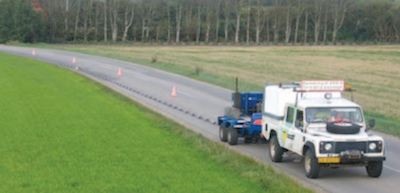
Land streamerI wandered past a poster yesterday morning about land streamers. The last I'd seen of this idea — dragging a train of geophones behind a truck — was a U of C test at Priddis, Alberta, by Gabriella Suarez and Rob Stewart. I haven't been paying much attention, but this was the first commercial implementation I'd seen – a shallow acquifer study in Sweden, reported by Boiero et al. The truck has the minivibe source right behind it, and the streamer after that. Quicker than juggies!

I don't know if this is a function of my recent outlook on conferences, but this was the first conference I've been to where all of the best things have been off-site. Perhaps the best part of the week was last night — a 3-hour geek-fest with Evan, Ben Bougher, Sam Kaplan, and Bernal Manzanilla. The conversation covered compressive sensing, stochastic resonance, acoustic lenses, and the General Inverse-Problemness of All Things.

As I mentioned last week, I hung out every day in the press room, waiting for wiki-curious visitors. We didn't have many drop-ins (okay, four), but I had some great chats with SEG staff, my friend Mike Stone, and a couple of other enthusiasts. I also started some fun projects to move some quality content into SEG Wiki. If you're at all interested in seeing a vibrant, community-driven space for geophysical knowledge, do get involved.

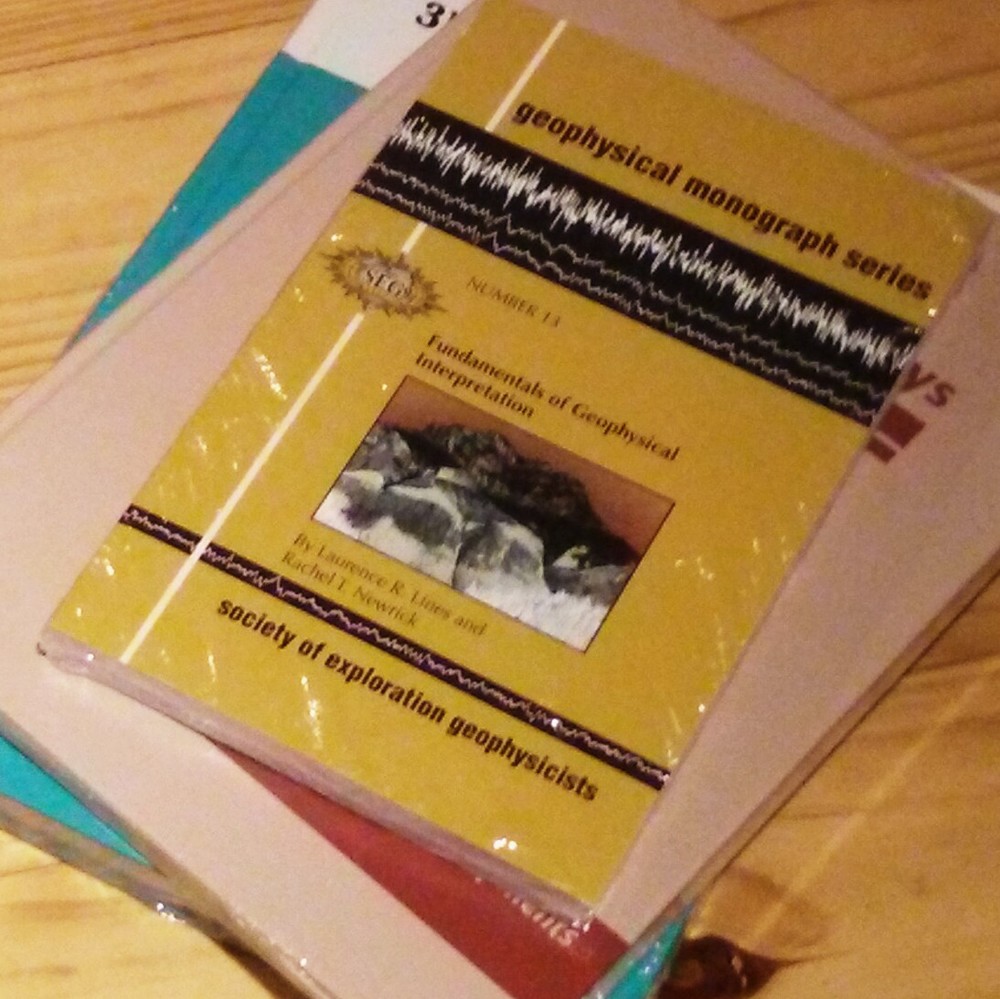
I bought some books in the Book Mart yesterday: Planning Land 3D Seismic Surveys by Andreas Cordsen et al., 3D Seismic Survey Design by Gijs Vermeer, and Fundamentals of Geophysical Interpretation by Larry Lines and Rachel Newrick. We're increasingly interested in modeling, and acquisition is where it all begins; Lines and Newrick was mostly just a gap on the shelf, but it also covers some topics I have little familiarity with, such as electromagnetics. Jennifer Cobb, SEG publications manager, showed me the intriguing new monograph by geophysical legend Enders Robinson and TLE Editor Dean Clark — I can't quite remember the title but it had something to do with Sherlock Holmes and Albert Einstein — a story about scientific investigation and geophysics. Looking forward to picking that up.

That's it for me this year; I'm writing this on the flight home. Evan is staying for the workshops and will report on those. As usual, I'm leaving with a lot of things to follow up on over the next weeks and months. I'm also trying to sift my feelings about the Annual Meeting, and especially the Exhibition. So many people, so much time, so much marketing...

The future is uncertain

Image: Repsol, SEG. Click for the abstract.

SEG Day 2. In the session entitled Exploration and Uncertainty Analysis, I was underwhelmed with the few talks that I attended, except for the last one of the session entitled, Measuring time-map uncertainty

Static uncertainty

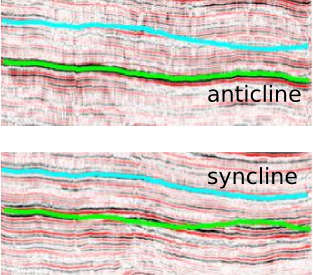
It is commonly uttered that different data processing companies will produce different results; seismic processing is non-unique, and so on. But rarely do I get to see real examples of the kind of variances that can occur. Bruce Blake from Repsol showed seismic imaging results that came back from a number of contractors. The results were truly shocking. The example he showed was an extreme case of uncertainty caused by inadequate static solutions caused by the large sand dunes in Libya. The key point for me is exemplified by the figure shown on the right: the image from one vendor suggests a syncline, the image from the other suggest an anticline. Beware!

A hole in the theory

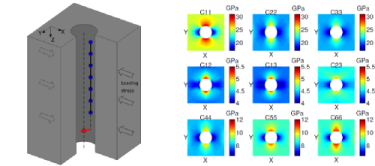
In the borehole sonic session, Xinding Fang, a student from MIT, reinforced a subtle but profound idea: it is tricky to measure the speed of sound in a rock when you drill a hole into it. The hole changes the stress field, and induces an anisotropic stiffness around the circumference of the borehole where sonic tools make their measurements. And since waves take the shortest travel path from source to receiver, speeds that are measured in the presence of an artificial stress are wrong.

Image: Xindang Fang, SEG. Click for the abstract.

The bigger issue here that Xinding has elucidated is that we routinely use sonic logs to make time-depth relationships and tie wells, especially in the absence of a check-shot survey. If it works, it works, but if ever discrepancies exists between seismic and well, the interpreter applies a stretch or a squeeze without much thought. Some may blame the discrepancy on dispersion alone, but that's evidently too narrow. Indeed, we rarely bother to investigate the reasons.

There's a profound point here. We have to drop the assumption that logs are the 'geological' truth upon which to hang an interpretation. We have to realize that the act of making the measurement changes the very thing we want to measure. 

Past, present, future SEG

Today was the first day of the SEG Annual Meeting in Houston. 

Last night we wandered around the icebreaker, still buzzing from the hackathon. The contrast was crushing. The exhibition is gigantic — it's an almost overwhelming amount of marketing. My thoughts on what the exhibition hall is, and what it represents, are not fully formed and might be a bit... ranty, so I will save them for a more considered post. 

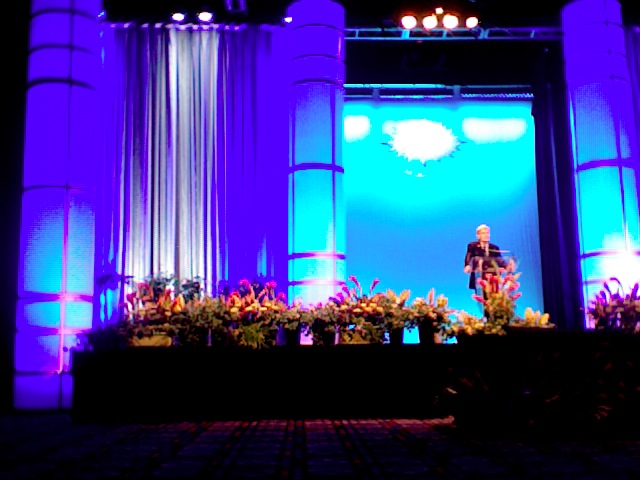
As usual, SEG kicked off with a general session — much better attended this year, but also much less ambitious. At least 300 members came to hear outgoing president David Monk's perspective on SEG's future. His address mostly looked backwards, however, at the trends over the last few years. I guess the idea is to extrapolate from there... But maybe we can do even better than recent years? We mustn't forget to do completely new and unexpected things too. 

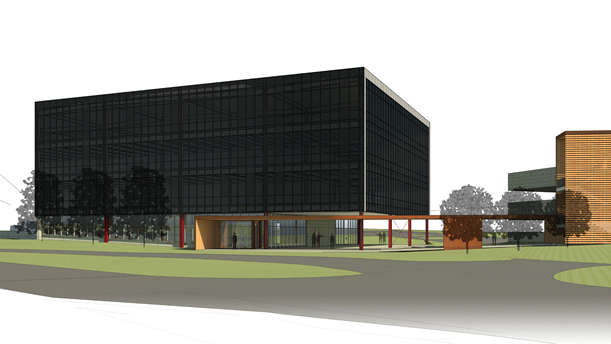
At the end of his slot, Monk showed some animated renderings of SEG's new building in Tulsa. The movie was accompanied by an almost comically strident anthem — evidently it is a big deal. As well as having a smart new office, the real estate will turn in some smart new revenue from other tenants. Ground was broken on Friday, and the opening is expected to be in December 2014. As you see, the architects understood industrial geophysics quite well, opting for a large black box

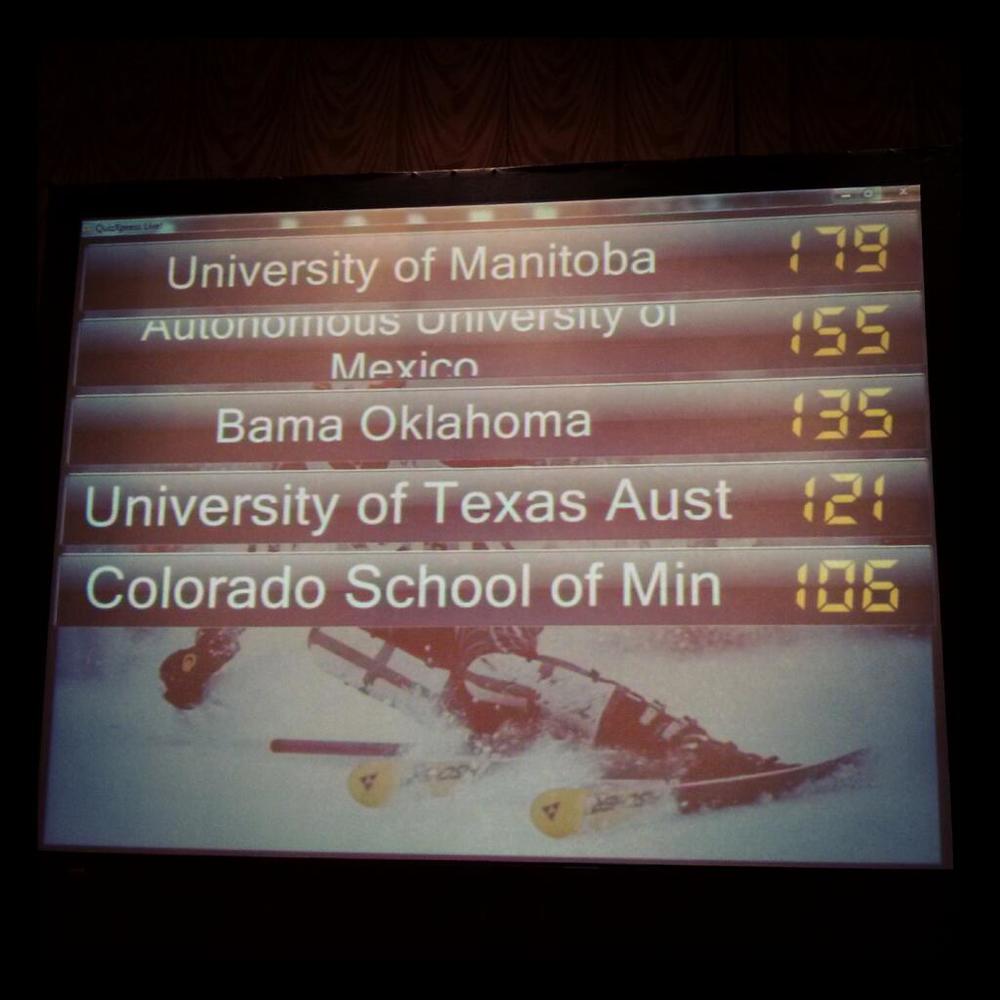
At the end of the day, Canada strode home to yet another SEG Challenge Bowl victory as the University of Manitoba fought off the Autonomous University of Mexico and Colorado School of Mines to prove that, while Texas might be the home of the industry, Canada is the home of exploration geophysics. 

Where's all the geophysics? Evan is compiling some technical highlights from the day as I type. Stay tuned for that. 

If you're at the conference, tell us what you've enjoyed most about the first 24 hours.

Garage geoscience

The Geophysics Hackathon 2013 is over. It was awesome. You should have been there.

The backers

I didn't make a big effort to find sponsors, because I didn't need to — just like the participants, they self-select. dGB Earth Sciences, Enthought, and OpenGeoSolutions are the leaders in the business of open geophysical software. Their support and encouragement means a lot to me personally, and is having a huge impact on our community. Please support them when you have the chance. We need companies like these.

The hackers

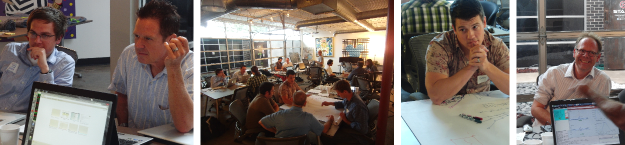
There was not too much of a plan. We were keen to allow organic collaboration to happen. So the hackers arrived on Saturday morning, and spent an hour or two matching projects to interests and skills. They settled down to work at about 10:30, and the creative buzz in the room was palpable.

The projects that emerged were:

  • Data viewers for amorphous well data masses, addressing uncertainty due to data disorganization
  • A seismic signal processing sandbox in the web browser, addressing resolution uncertainty
  • Mobile and desktop apps for on-the-fly time–depth transformation, with error bars

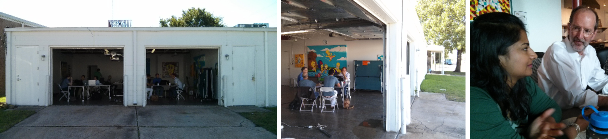
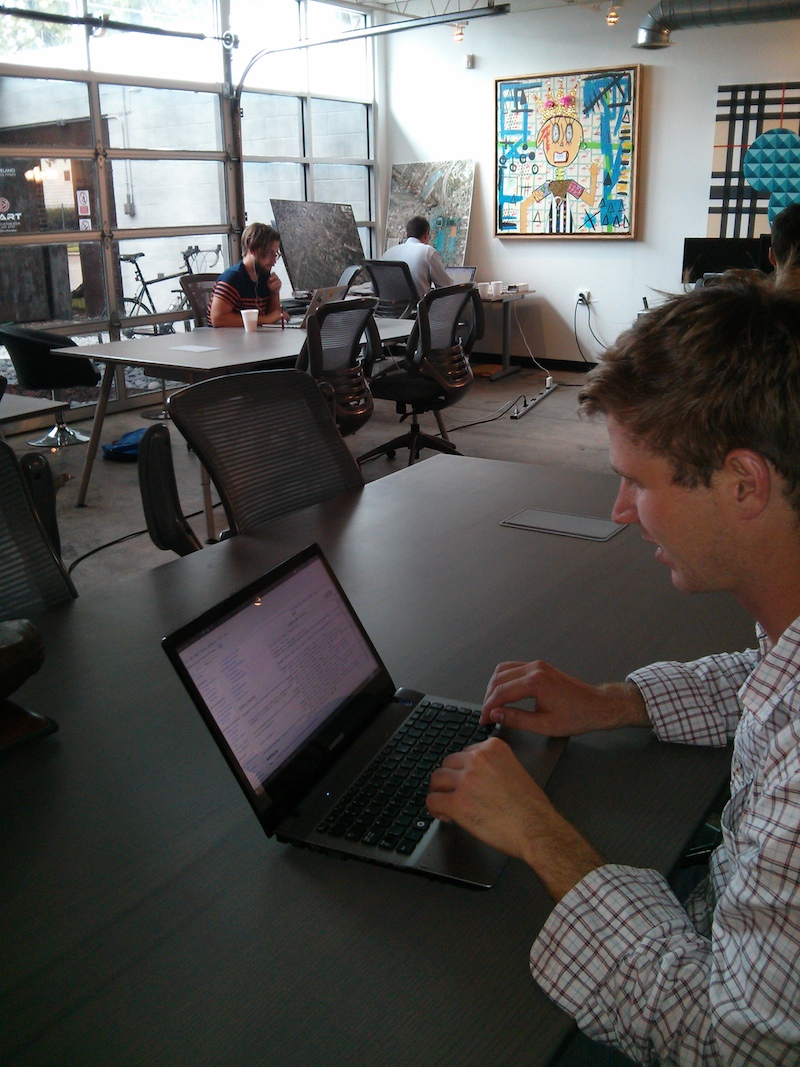
On Sunday we ended up in START Houston's garage space, with the doors open to the beautiful fall morning. It had the ambience of a picnic. A sunny Sunday morning with cinnamon coffee, breakfast tacos, Python, and geophysics — what more could you ask for?

The geeks among you might be interested to know what sort of hardware the hacking geophysicists were developing their ideas on. Turns out it was perfectly evenly distributed: 4 each of Mac, Windows, and Linux. Of the Linux distros, there was 1 each of Centos, Ubuntu, crunchbang, and OpenSuse.

At the request of Chris Chalcraft, I also did an impromptu poll of code editor software. This was similarly diverse:

The other backers

Chris Krohn has been a true champion of the event. On Saturday, she brought new SEG president-elect Chris Liner to visit the event — his natural curiosity and enthusiasm are infectious, and lifted everyone present. I hope he's able to realize some of his vision during his presidency. (You do read his blog, right?)

Today she returned with Dennis Cooke and Peter Annan. They all graciously acted as judges. The other judges were Paul de Groot and Eric Jones, two of our generous sponsors, and Maitri Erwin, one of Agile's closest friends. Though they couldn't stick around, we also had visits from Zane Jobe and Joe Dellinger — much appreciated votes of support.

We'll be blogging about the SEG Annual Meeting all week... when the dust has settled a bit, we'll tell you more about the projects the hackers built. It's amazing what you can do in 2 days.

Places for ideas in Houston

Evan has told before of how productive he is at the HUB Halifax. And ever since I've been involved in The HUB South Shore, a co-working space in my small town, I've been keenly interested in communal and collaborative workspaces. I think they're a powerful model for independent scientists and entrepreneurs, perhaps even inside large companies too. 

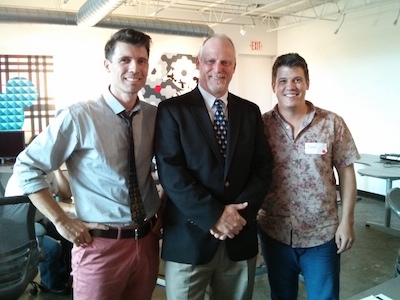
Because of this, and because most hotels are such boring venues (there are always exceptions), we decided to host the hackathon this weekend at a co-working space, START Houston (right). A converted urban loft residence (well, a loft on the ground floor), it's got downtown character with an artistic edge. Evan and I gatecrashed a startup pitch coaching session while we were there — we heard 3-minute pitches from 4 Houston startups, including eOilBoom, an interesting crowdfunding platform for oil and gas concerns, and Philantro, a curated social layer for non-profits and philanthropists.

We need this level of ideation, business-model testing, and experimental entrepreneurship in subsurface science. How do we make this happen?

Co-working? Co-reseach!

Two weeks ago, I tweeted something about the hackathon, and Jacob at Brightwork Co-Research tweeted back at me:

Just another one of the wonderful serendipities of social media. That one connection is worth a lot to me, and is characteristic of the generous community of scientists on Twitter.

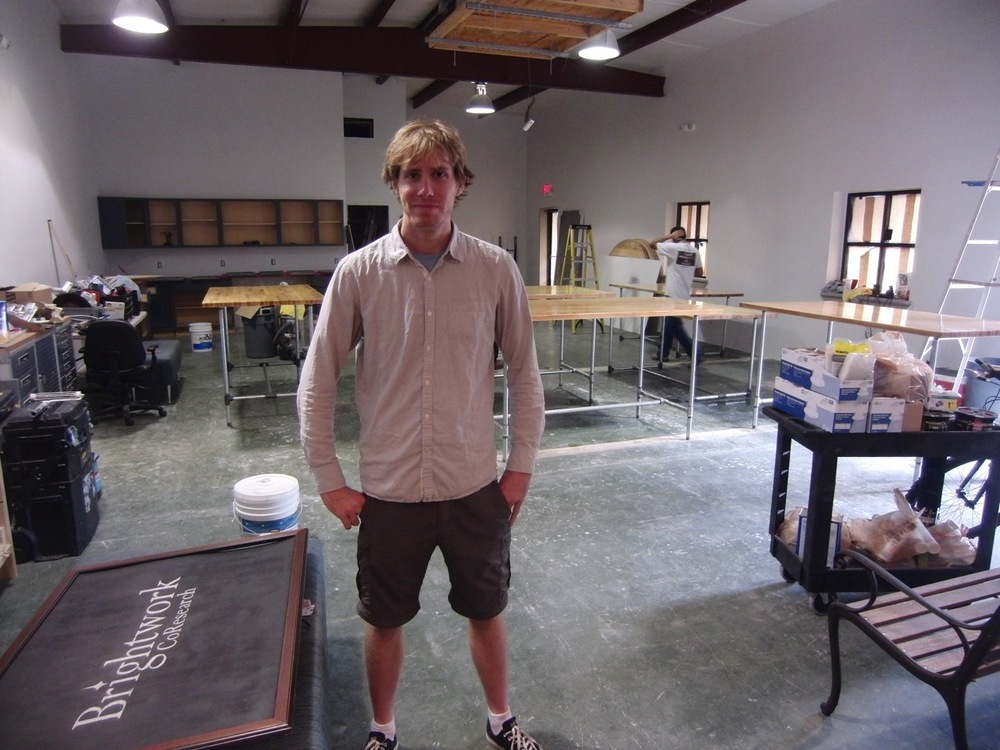
While in town, we thought we'd drop in and see what Brightwork is about... and I've rarely been more excited. Jacob Shiach (left) showed us the embryonic space neighbouring Rice University, complete with a rapid prototyping space (think of hardware hacking soldering, 3D printers, and so on), and a wet lab for full-on biotechnical research. In under a year, Jacob plans to fill the space with researchers in bio, physics, math, technology, and any other scientific discipline that needs a lab outside of academia or industry. What can independent researchers do when they have all the tools of big research? What would you do with your own lab?

These places exist

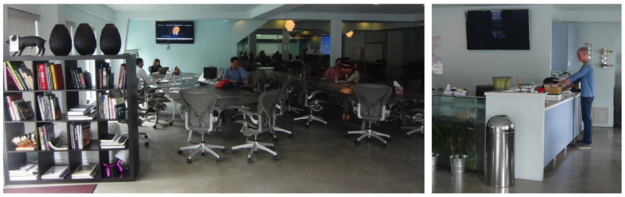
To complete our tour, we headed over to Platform — a more conventional co-working space around the corner from Brightwork. The familiar buzz and productive vibe of co-working hits you immediately: here a livestream of TEDxHouston City2.0, there a new startup hashing out customer segments for their product. Imagine an office full of smart, energetic, friendly people who don't actually have to work together, no meetings, and no sign above the sink saying "Your mother doesn't work here!". Yeah, those places exist.